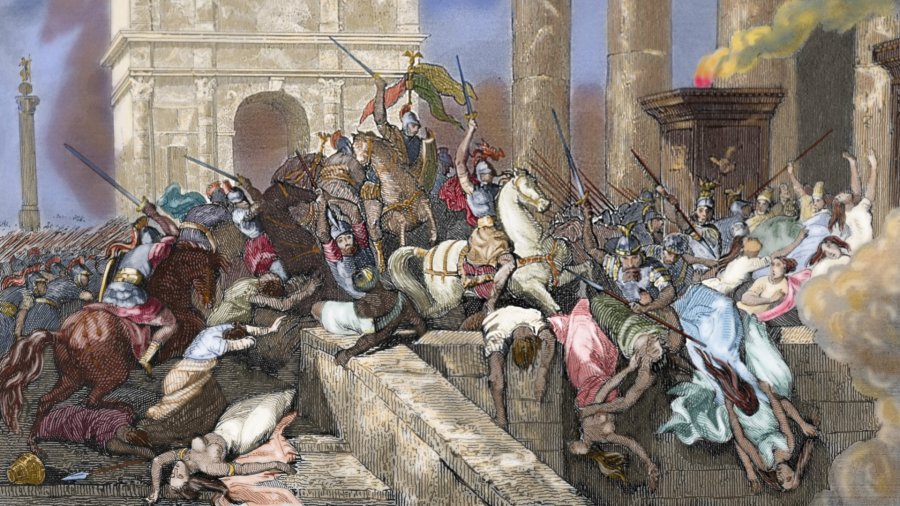
Empires rarely collapse at the moment foreign armies enter their capitals. By that stage, the deeper systems sustaining that power have often already begun to fragment. Military defeat is frequently the final manifestation of a much longer process of strategic erosion.
Recent quantitative research on Late Antiquity offers an important framework for understanding the underlying mechanics of imperial decline. In their January 2026 study, “Trade and the End of Antiquity”[i], Johannes Boehm and Thomas Chaney reconstruct patterns of trade, monetary circulation and economic integration across Europe, North Africa, and the Middle East from the 4th to the 10th century. Using hundreds of thousands of coin records, the study provides measurable evidence that the decline of Rome was not merely a political or military process. It was fundamentally a crisis of circulation.
The Roman Empire functioned as a circulation architecture. Its power depended not only on territorial expansion or military superiority, but also on its ability to maintain the secure movement of goods, money, taxation, military logistics and commercial trust across a vast and interconnected Mediterranean system. The Mediterranean was not simply sea-linking territories. It was the central artery of imperial integration.
The coin evidence demonstrates that during periods of Roman strength, monetary circulation remained deeply interconnected throughout the empire. Coins minted in Rome, Constantinople, Carthage, Ravenna, and other major centers circulated widely across Europe, North Africa, and the eastern Mediterranean. Long-distance trade remained active because merchants trusted the broader imperial framework. Trade routes were comparatively secure, maritime movement remained protected, and the imperial system preserved sufficient coherence to sustain commercial predictability across large distances.
The importance of coinage extended beyond simple exchange. Roman gold and silver coins possessed intrinsic value tied directly to the precious metals they contained. Unlike modern fiat currencies, their worth was not dependent solely upon confidence in political institutions. As imperial authority weakened, trust gradually migrated from the political center and toward assets whose value no longer depended upon the coherence of the imperial system itself. Monetary confidence increasingly detached itself from imperial authority and remained embedded in the metallic value of the coin itself.
One of the study’s most important findings is that trade did not suddenly disappear before the fragmentation of Roman power. Rather, circulation became progressively regionalized. Coins continued to move, but they increasingly stopped moving across the entire imperial system. Long-distance integration weakened while smaller blocs became more economically self-contained. Economic gravity gradually shifted away from the traditional imperial center.
Empires begin to decline when they cease being the safest and most trusted system through which commerce moves.
This represented one of the earliest structural indicators of imperial decline.
Empires rarely weaken because commerce vanishes entirely. More often, they begin to decline when the imperial center loses its role as the indispensable organizer of circulation. Once peripheral regions begin developing alternative commercial networks, new centers of gravity emerge outside the traditional core. Commercial actors adapt to changing realities by prioritizing regional predictability over imperial cohesion. Economic systems gradually fragment into increasingly autonomous spheres.
The Roman case demonstrates this process with unusual clarity. As the empire gradually lost military and political control over strategic territories, maritime corridors and key chokepoints, the security architecture sustaining Mediterranean integration weakened. Critical trade routes became increasingly contested. Piracy, instability, regional warfare, and declining administrative capacity raised both the cost and the risk of long-distance exchange.
Merchant confidence depends heavily upon predictability. Trade flourishes when commercial actors believe routes will remain secure, contracts enforceable, and political authority sufficiently stable to protect circulation. Once those assumptions weaken, economic systems adapt defensively. Merchants shorten commercial networks, rely more heavily upon regional exchanges, and redirect capital towards more stable environments.
The Roman economy gradually entered precisely such a phase.
The study demonstrates that after the seventh century, cross-Mediterranean circulation weakened dramatically. North-south flows declined while regional circulation within emerging Islamic and northwestern European sphere intensified. The Mediterranean ceased functioning as a unified Roman commercial system and instead fragmented into competing regional networks. The old imperial center no longer controlled the principal arteries of exchange.
At the same time, alternative systems emerged that proved sufficiently powerful to replace portions of the previous order. Economic activity increasingly shifted toward regions outside the traditional Roman core. New commercial hubs developed under the expanding Islamic world and within the rising Frankish regions of northwestern Europe. Rome did not fragment into economic emptiness. It lost centrality because viable alternatives emerged around it.
This dynamic remains strategically important far beyond antiquity. Large-scale political systems in every era depend upon their ability to preserve trusted circulation across trade, financial, logistical, and maritime networks.
Empires do not necessarily weaken because commerce disappears. They weaken because they cease to be the indispensable framework through which commerce flows.
The Roman experience also reveals a broader strategic reality: military control, economic integration, monetary circulation, and political legitimacy are deeply interconnected. Once one element weakens significantly, the others gradually become more vulnerable. The erosion of territorial control weakens maritime security. Reduced maritime security undermines merchant confidence. Declining confidence weakens long-distance trade. Weakening trade reduces fiscal capacity. Reduced fiscal capacity limits military projection. Diminished military projection further weakens control over circulation networks. Over time, this produces a self-reinforcing cycle of fragmentation.
The coin data assembled by Boehm and Chaney provides measurable evidence of this process.
Perhaps the most important lesson from Rome is that imperial decline often begins invisibly. Political institutions may continue functioning formally long after the strategic foundations beneath them have begun eroding. Capitals may remain wealthy. Armies may still exist. Official borders may still appear intact on maps. Yet beneath the surface, the system’s circulatory architecture may already be fragmenting.
The Roman Empire ultimately lost more than territory. It lost the ability to remain the central organizing structure of economic movement across its sphere of influence. Once circulation became decentralized, regionalized and reorganized around alternative centers, the imperial core gradually ceased to be indispensable.
The research of Boehm and Chaney offers an important reminder that trade routes, strategic corridors, monetary systems, maritime security, and commercial trust are not secondary components of power. They are among its foundational pillars. The security of circulation is inseparable from the durability of large political systems.
The Roman experience demonstrates that empires endure not simply through military strength or territorial scale, but through their ability to preserve secure, trusted, and integrated systems of circulation. Once those systems fragment and alternative centers emerge, imperial decline begins long before formal collapse becomes visible.
Endrit Reka is Director of the Security Policy Department at the Albanian Policy Center and a national security analyst focused on strategic affairs, NATO, and geopolitical competition. /Realcleardefense.com
© SYRI.net

 Denonco

Merrni lajmet më të fundit nga SYRI.net në çdo moment dhe kudo që të jeni!





 Kërcënimi i Iranit shkon përtej Ngushticës së Hormuzit
 Demokratët nuk janë në gjendje të mirë
 Fundi i hidhur i identitetit antifashist të Gjermanisë